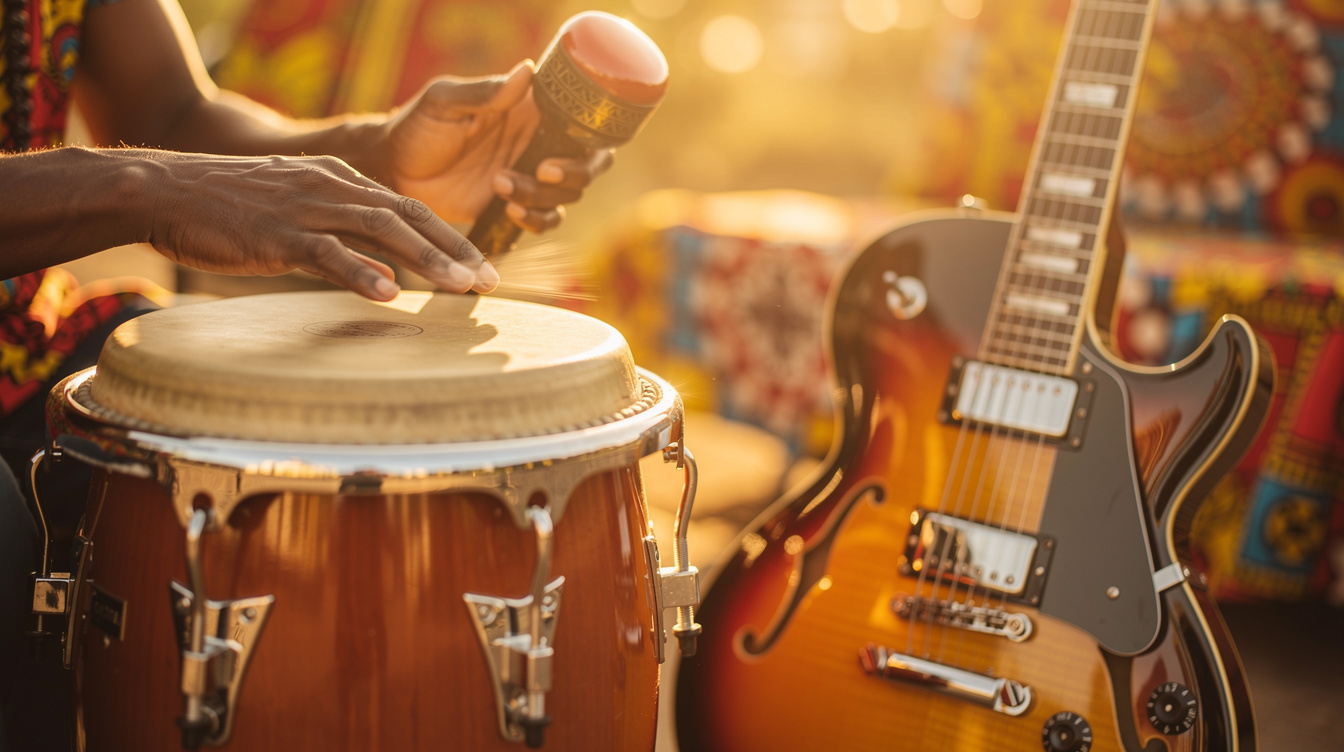
Modern Afrobeats — the Afropop and Afro-fusion sound coming out of Nigeria, Ghana, and across the diaspora — is built on groove and bounce. It's percussion-led: layered shakers, congas, and a distinctive kick pattern that locks into a rolling, danceable pocket. Add a bright guitar stab, a warm melodic bassline, and a sing-song call-and-response feel, and you have the foundation. None of it requires expensive gear — it's all groove, and groove is programmable.
This guide covers what makes Afrobeats sound the way it does — the tempo, the percussion, the guitar, the bass — and how to build one in Onomo Studio, free and entirely in your browser.
What defines the Afrobeats sound
Tempo. Modern Afrobeats sits around 100–115 BPM — mid-tempo, relaxed but danceable. Around 105–110 is a common pocket.
Feel. Syncopated and rolling. Afrobeats grooves are built from interlocking percussion that bounces off the beat, creating a continuous, hypnotic motion. It's warm, melodic, and feel-good even when the lyrics are serious.
Key sounds. Layered percussion (shakers, congas, woodblocks, claps). A signature kick pattern that's syncopated rather than four-on-the-floor. Bright highlife / palm-wine guitar stabs. Warm, melodic basslines (and on some Afro-fusion records, deep log-drum-adjacent low end). Plus mellow keys, pads, and vocal chops.
The drums and percussion
This is the engine of Afrobeats, so spend the most time here. Program on the step sequencer at ~108 BPM.
- Kick — the signature Afrobeats kick is syncopated. A very common pattern places kicks roughly on beat 1 and the "and" of beat 2 / around beat 3, giving that off-kilter bounce rather than a steady pulse. Don't put a kick on every beat — the groove comes from where the kick isn't.
- Snare / clap / rim — often a rim or clap on the backbeat (beats 2 and 4), sometimes with extra syncopated hits. Keep it light, not a heavy backbeat slam.
- Shakers — essential and busy. Lay a continuous shaker pattern (often swung 16ths) and use per-step velocity to make it roll and accent.
- Congas / percussion — this is where the magic is. Layer congas, woodblocks, and toms in interlocking, syncopated patterns that answer each other. The percussion should feel like a conversation between several players.
Use swing so the groove bounces, and probability so busy percussion fires with subtle variation instead of looping identically. The goal is a continuous, danceable roll where the layers lock together.
The bass
Afrobeats bass is warm, round, and melodic — it moves with the song rather than just thumping roots. Pick a smooth synth bass (a subtractive engine with a soft tone works beautifully) and write a bassline in the piano roll that follows the chords but with melodic movement and syncopation that locks to the kick. On Afro-fusion records you'll sometimes hear a deeper, log-drum-adjacent low end — you can design that on Super808 or Bazyr with a percussive pluck if you want that flavor. Either way, land the bass with the kick so the low end grooves as one.
Chords, guitar, and melody
The melodic signature of Afrobeats is the bright guitar stab — clean, plucky, highlife/palm-wine-style guitar playing short rhythmic figures and arpeggios. Recreate it with a plucked or clean-guitar-like synth sound from Studio's engines, and write a rhythmic, syncopated riff in the piano roll — short notes that bounce against the percussion in call-and-response. This single element instantly signals "Afrobeats."
For harmony:
- A simple, warm chord progression (often major or relative minor) on soft keys or pads, usually just 2–4 chords looping.
- Guitar and synth stabs answering the vocal and percussion.
- Light vocal chops and ad-libs for the genre's signature human, sing-song feel.
Keep melodies bright and uplifting — Afrobeats leans warm and major-flavored even in emotional songs.
Arrangement and mix tips
- Groove first, sections second. Lock a great 4–8 bar percussion-and-bass groove, then arrange around it with the timeline: a sparse intro, the full groove, a chorus that adds the guitar hook, a stripped breakdown.
- Use space and dynamics. Mute percussion layers in the verse and bring them back for the chorus. Subtraction creates the lift.
- Mix for warmth and clarity. Use Track EQ to keep the percussion crisp up top and the bass full but controlled at the bottom. Pan your percussion layers wide so the interlocking parts each have their own space in the stereo field — this is key to that lush, surrounding groove.
- Sidechain if your low end is heavy. If you're using a deep Afro-fusion bass, a gentle sidechain (SuperComp) ducking the bass under the kick keeps the bottom clean and pumping.
- Add depth. A touch of reverb and delay on the guitar stabs and vocal chops gives the airy, polished sheen of modern Afropop.
How to do it fast in Onomo
A groove comes together quickly:
- Set tempo to ~108 BPM.
- Grab percussion from Foundry. The free, rule-based Kit Generator and Loop Generator can give you a shaker-and-conga starting point sent straight to Studio — then layer and swing it.
- Program the syncopated kick (off the grid, not four-on-the-floor) plus interlocking shakers and congas.
- Write a warm, melodic bassline locked to the kick.
- Add a bright guitar stab riff on a plucked/clean sound, syncopated and bouncing.
- Add warm chords, pads, and vocal chops.
- Optionally use Airess. Airess, Studio's AI assistant, can drop an editable chord loop into your project to build the keys and guitar parts around.
Brand new to beats? The from-scratch walkthrough covers the basics. To finger-drum your percussion by feel, try the OPC pad grid.
FAQ
Is this really free? Yes. Programming the groove, designing the bass, writing the guitar parts, and mixing in Studio are free — no download, no plugins. Everything runs in your browser.
Do I need real instruments or a guitarist? No. The bright highlife guitar can be played on a plucked or clean synth sound in the piano roll, and all the percussion is programmed. Real recordings are optional flavor, not a requirement.
Can I make Afrobeats on my phone? You can sketch grooves in a mobile browser, but layering interlocking percussion and writing guitar riffs in the piano roll are far easier on a laptop or desktop.
Why does my Afrobeats groove feel stiff or generic? Usually the kick is on every beat (make it syncopated instead) and the percussion is one stacked part rather than several interlocking ones. Build the groove as a call-and-response between simple percussion layers, and add swing.
What BPM is Afrobeats? Modern Afrobeats typically sits at 100–115 BPM, with many records around 105–110 — mid-tempo and danceable.
That's the blueprint. Open Studio, build the percussion conversation first, and let the groove roll — that's Afrobeats.
Ready to try it yourself?
Onomo is a full DAW in your browser — synths, drums, effects, and export. Free to start, nothing to install.
Open Studio and make one