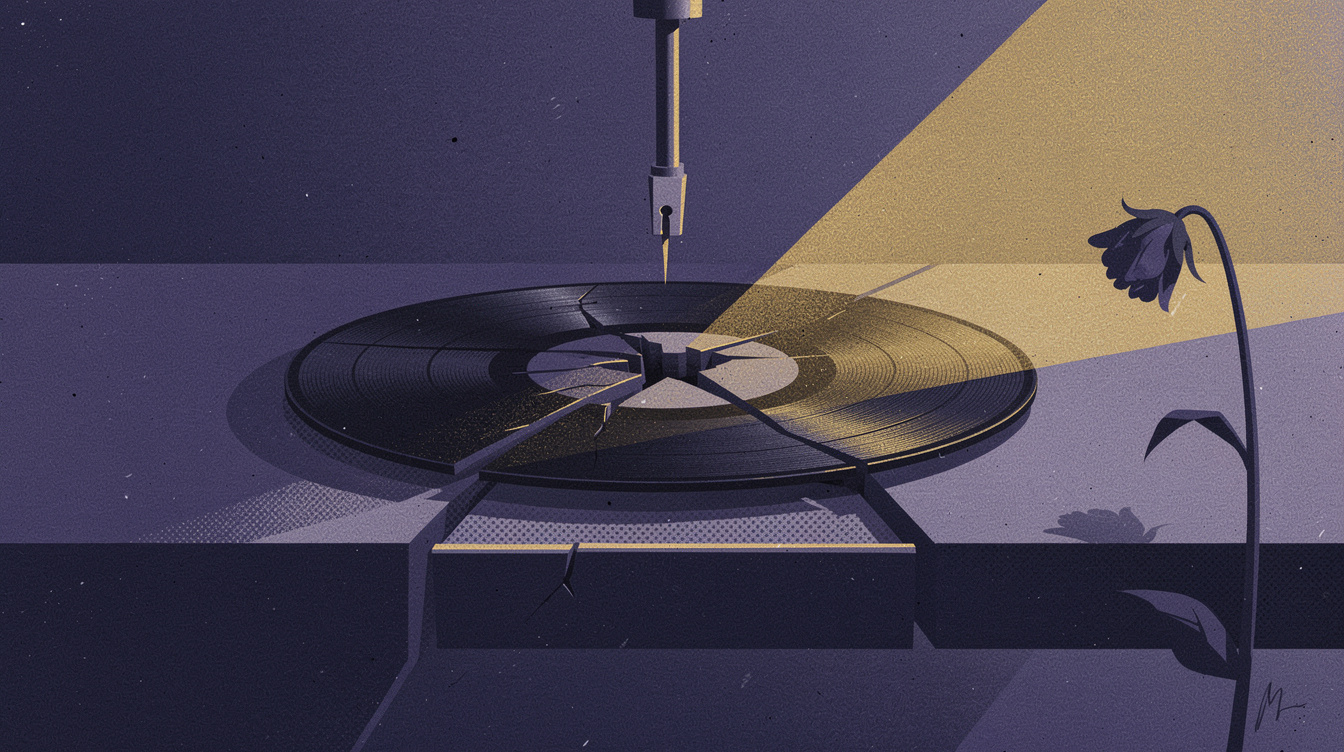
You've been on this track for three weeks. Nobody has heard it. In that time you have nudged the same hi-hat two milliseconds forward and back roughly forty times, redone the same vocal take until it lost whatever made it good, and swapped the snare for a "better" one that is, on any honest listen, identical. It feels like you're working hard. It feels like high standards. It feels like the thing that's going to make you great.
It's the thing that's keeping you small.
Perfectionism is the most respectable creativity-killer there is, because it wears the costume of caring. Nobody scolds you for it; they nod and say wow, you really take it seriously. But look at what it's actually doing: it's keeping your music on your hard drive instead of in the world, keeping you from the only thing that actually makes you better, and quietly convincing you that the problem is the work when the problem is the chase. Let's take it apart.
The ideal you're chasing isn't real
Start with the engine of the whole thing: you are comparing your track to a version that does not exist.
Somewhere in your head is a "perfect" version of this song — flawless, complete, exactly as good as the feeling that made you start it. Every time you listen to what you've actually made, you measure it against that ghost, and it always comes up short. So you keep tweaking, chasing a target that recedes the moment you approach it, because it was never a real place on the map. No song has ever been perfect. Not the ones you worship. They committed, shipped, and moved on — and what you hear as flawless is just a finished decision they stopped second-guessing.
You will never feel 100% about a track. Never. So if "I feel 100% about this" is your definition of done, you have quietly committed to finishing nothing for the rest of your life. The perfectionist isn't someone with standards too high to meet. They're someone chasing a number that doesn't exist, and mistaking the chase for diligence.
High standards are good. Perfectionism is the broken version.
This is the distinction that frees people, so sit with it: caring about quality and being a perfectionist are not the same thing. One builds you; the other eats you.
Psychologists actually separate these. There's an adaptive version — high standards paired with self-compassion when you fall short, motivated by "how good can I make this?" — and a maladaptive version — high standards paired with brutal self-criticism, motivated by "what will they think of me if this isn't perfect?" The first one is fuel. The second one is associated with anxiety, procrastination, and burnout, and it's the one quietly running your studio sessions.
The researcher Brené Brown draws the cleanest line: **"Healthy striving is self-focused — how can I improve? Perfectionism is other-focused — what will they think?"** That's the tell. When you can't release a song, dig into the fear underneath. Is it "I want this to be better" (striving — great, keep going)? Or is it "I'm terrified of what people will think of me if it's not flawless" (perfectionism — that's not about the music, that's about protecting yourself from judgment)? The first improves the work. The second just prevents it from ever facing the world. Perfectionism, at bottom, isn't about excellence at all. It's a shield against being seen and found wanting.
The fix: constraints, deadlines, and a real reference
Knowing perfectionism is a trap doesn't release you from it. You need mechanics that take the infinite-tweaking option off the table.
Set a deadline and mean it. Infinite time is the perfectionist's prison — there's always one more thing to fix because there's always tomorrow. A deadline ("this goes out Friday, finished or not") does something physical to your brain: it forces the decisions you'd otherwise dodge forever and ends the invisible revising that feels like progress but is really just fear in motion. It can be self-imposed and soft. It still works. Pick a date out loud.
Work inside hard constraints. Limitless choice is what makes perfectionism possible — if you could swap any sound, you'll consider swapping every sound, forever. So take the choices away on purpose. One synth. No new samples after the first hour. A two-hour cap. Eight tracks, no more. Constraints kill the "but what if I tried..." spiral by removing the option, and the paradox is that you'll end up more creative inside the fence, because you're solving a defined problem instead of drowning in an open ocean of maybes.
A/B against a real, finished track — not the ghost. Stop measuring your song against the imaginary perfect version (unanswerable, infinite). Pull up an actual professional track in your genre and ask "is mine in the same ballpark?" That turns a question you can never satisfy ("is this perfect?") into one you usually can ("is this good enough to stand next to that?"). The answer is almost always yes — far sooner than your perfectionism will admit.
Separate making from judging. You cannot create and critique in the same breath; do both at once and everything grinds to a halt. Get the parts down in one pass with the inner critic muzzled, then switch into editing mode and commit. Trying to perfect each piece as you place it is how a three-hour song becomes a three-month one.
Ship something deliberately "good enough." If you're deep in the hole, the only way out is to finish a few tracks you've decided in advance will be good-enough-not-great. Finish them fast. Release them. The point isn't a masterpiece — it's rebuilding the muscle of crossing a finish line, which has atrophied from never being used. You can raise the bar back up once you remember how to ship at all.
What you actually lose to perfectionism
It's easy to think the cost of perfectionism is just "slow." It isn't. The real cost is everything downstream of a song you never released.
You lose the learning — every track you don't finish is a set of reps you didn't take, so the skill that would've come from finishing it never arrives, and you stay stuck at exactly the level that's frustrating you. You lose the audience — people can't connect with, share, or be moved by music that's trapped on your drive; the song that might've meant everything to one stranger never reaches them. And you lose yourself, slowly, to a relationship with your own art that's all anxiety and no joy, where every session is a referendum on your worth instead of a place you get to play.
That last one is the quiet tragedy. You got into this because making music felt good. Perfectionism takes the most joyful thing you do and turns it into a test you can never pass. Letting go of the impossible standard isn't lowering your ambition. It gets the joy back, and the catalog, and the growth. The musicians making work you love aren't perfect. They're brave enough to be finished.
So go pick the track you've been polishing into oblivion. Set a deadline of today. Decide right now it doesn't have to be perfect — it has to be true and finished. Then let the world hear it. The perfect version was never coming. The finished one is the only one that was ever going to matter.
FAQ
Isn't perfectionism just having high standards? No — and conflating them is what keeps people stuck. High standards (psychologists call it adaptive striving) ask "how can I make this better?" and come with self-compassion. Perfectionism asks "what will they think of me if it's not flawless?" and comes with harsh self-criticism and paralysis. One improves your work; the other prevents it from ever being finished or heard.
Doesn't "done is better than perfect" just excuse sloppy music? It's the opposite of an excuse. A finished okay song teaches you a dozen real skills; a perfect unfinished song teaches you nothing because it never leaves your head. Releasing isn't the opposite of improving — releasing is how you improve. The fastest-growing producers ship, learn, and ship again.
How do I know when a song is actually done? When it communicates your idea in a way that feels true to you — not when you can't possibly improve it (you always can). A useful test: A/B it against a real finished track in your genre. If it's in the same ballpark, it's done. "Done" is a decision you make, not a feeling that finally arrives.
Why do I keep tweaking tiny things no one will notice? Usually because the tweaking is a way to avoid the scarier step: committing and being judged. Moving a hi-hat two milliseconds feels productive and safe; releasing feels exposed. Naming that — "this isn't refinement, it's avoidance" — is the first step. Deadlines and constraints take the endless-tweak option off the table.
What's the single fastest way to break out of it? Finish a few tracks you've decided in advance will be "good enough, not great," fast, and release them. It rebuilds the muscle of finishing, which is what's actually broken. Then add a deadline and a hard constraint (one synth, two hours) to your next one so perfectionism has nowhere to hide.
The perfect version was never coming — the finished one is. Start something, set a deadline, and let it go. There's more from Artist Life on the rest of the head game.
Ready to try it yourself?
Onomo is a full DAW in your browser — synths, drums, effects, and export. Free to start, nothing to install.
Start making something