An uncomfortable truth: a huge number of independent artists are owed money they never collect, simply because nobody ever explained how royalties work. Studies of the industry suggest the average independent artist leaves a large chunk of their earnings sitting unclaimed in what's called the "Black Box" — money that's theirs, going uncollected because they didn't register in the right places.
Royalties are confusing. But you don't need a law degree to understand the parts that matter. This is the plain-English version.
Heads up: this is general education, not legal or financial advice. Royalty systems vary by country and change over time, and your situation may differ. For decisions about real money, confirm specifics with a music attorney or a royalty specialist.
The one distinction that unlocks everything: two copyrights
Almost all the confusion about royalties melts away once you understand this single idea: every song is actually two separate things, with two separate copyrights.
The composition — the underlying song itself: the melody, the chords, the lyrics. The thing that stays the same whether it's performed by you, covered by someone else, or played on a piano. This is the publishing side, and it belongs to the songwriter(s).
The master — the specific recording of that song. The actual audio file people hear on Spotify. This is the master side (a.k.a. the sound recording), and it belongs to whoever owns the recording — usually the artist or their label.
Two copyrights means two completely separate streams of money, flowing through two completely different systems, to (potentially) two different owners.
And the part that should make you sit up: as a fully independent artist who wrote, recorded, and released your own song, you own both. You're the songwriter and the recording owner. That means you're entitled to both sets of royalties from the same song — but only if you go collect each one, because they come from different places.
The types of royalties (don't panic, it's only a few)
Within those two sides, money shows up in a handful of named forms. The ones that matter most to a streaming-era indie artist:
On the master (recording) side:
- Master / sound recording royalties — paid for the use of your specific recording. This is the big one from streaming and downloads, and as an independent artist you collect it through your distributor (the service that puts your music on Spotify, Apple, etc.).
On the publishing (composition) side:
- Mechanical royalties — generated every time a copy of your composition is made. That includes physical sales and downloads, but crucially also interactive streams (Spotify, Apple Music). Every stream owes a small mechanical royalty to the songwriter. In the US these are collected by The MLC (the Mechanical Licensing Collective).
- Performance royalties — generated when your composition is performed publicly: radio, live venues, TV, and yes, streaming too. These are collected by a PRO (Performing Rights Organization) — in the US, ASCAP or BMI.
There are others — sync royalties (when your music is licensed to film/TV/ads/games, often a big payday), neighboring rights (for the recording's public performance internationally), print, micro-sync — but for most independent artists starting out, master + mechanical + performance are the three you need to make sure you're actually collecting.
Who pays you, and through what
This is where artists lose money — not because they're not owed it, but because each royalty comes from a different collector, and they only signed up with one or two.
| Royalty | Side | Who collects it for you (US) |
|---|---|---|
| Master / recording | Master | Your distributor (DistroKid, TuneCore, etc.) |
| Mechanical (streaming) | Publishing | The MLC |
| Performance | Publishing | A PRO — ASCAP or BMI |
| Sync | Both | Negotiated directly / via a sync agent or publisher |
The trap is brutal in its simplicity: most indie artists set up a distributor (so they collect the master royalty) and maybe register with a PRO (so they get some performance royalties) — and then never register with The MLC, so the mechanical royalties from their streams just… sit there, uncollected. That's a big slice of the publishing money, gone, on every stream, forever, until you fix it.
What this actually pays (real numbers, roughly)
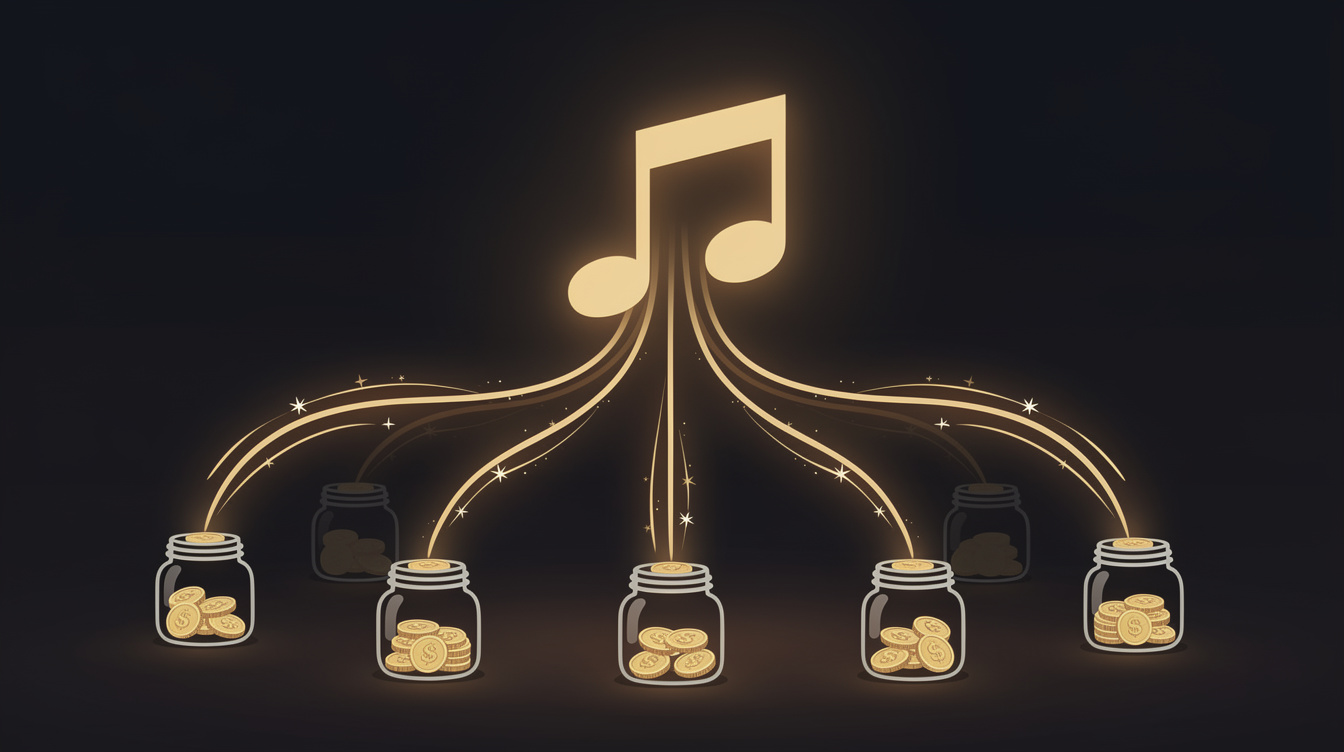
Per-stream royalties are famously tiny, and it helps to see why. A single stream splits into those two coins:
- The master royalty (recording side) is roughly $0.003–$0.005 per stream.
- The songwriter mechanical share (publishing side) is roughly $0.001–$0.002 per stream.
Streaming services pay out a large majority of their revenue to rights holders — on the order of three-quarters of it — but it's split across the recording owners and the songwriters/publishers, which is why any one coin is small. The takeaway isn't "streaming pays nothing." It's that streaming pays you across two channels, and if you only collect one, you're leaving a meaningful fraction of every stream behind.
Why the money takes forever to arrive
One more thing that confuses new artists: the delay. This is normal, not a scam.
- Distributors (your master royalties) typically pay monthly, with about a two-month lag — January's streams might land in your account in March.
- PROs (performance royalties) collect usage, process it, and pay quarterly, often 6–9 months after the performances happened.
So when you release a song and don't see money for months, nothing's wrong. The machines are just slow. Plan around it; don't panic about it.
What to actually do (the checklist)
You don't need to understand every nuance. You need to make sure all your coins are getting collected. As an independent artist who owns your masters and your publishing:
- Get a distributor to put your music on streaming platforms and collect your master royalties.
- Register with a PRO (ASCAP or BMI in the US) as both a songwriter and a publisher, to collect performance royalties.
- Register with The MLC to collect your mechanical royalties from streaming — this is the step almost everyone skips, and it's pure money you're otherwise giving up.
- Register your individual songs with each of those, not just your account. Unregistered works are exactly what ends up in the unclaimed Black Box.
- Keep your splits documented (more on that in our guide to split sheets) so when the money comes, everyone gets their correct share with no fights.
Do those, and you go from collecting one coin to collecting all of them — which, over a catalog and a career, is a large difference.
The bottom line
Royalties feel impossibly complicated, but the core is simple: your song is two copyrights (the recording and the composition), each generates its own money through its own collector, and your job is to register in all the right places so you actually receive every stream's worth instead of a fraction of it. The artists getting "more" out of streaming often aren't streaming more — they're just collecting more of what they were already owed.
FAQ
What's the difference between master and publishing royalties? Master royalties are for the recording (the audio file people stream); publishing royalties are for the composition (the song itself — melody, chords, lyrics). They're separate copyrights, paid through separate systems. As a fully independent artist you usually own both and can collect both.
Why am I not getting all my streaming money? Most likely because you only registered with a distributor and maybe a PRO, but not The MLC — so you're collecting your master royalties and some performance royalties, but not your mechanical royalties from streaming. Registering with all the right collectors is how you stop leaving money unclaimed.
Do I need a publisher? Not necessarily. As an independent artist you can self-publish and register directly with a PRO and The MLC (or use a "publishing administration" service that does it for you for a cut). A traditional publisher takes a larger share but does more work and pursues opportunities like sync. It's a trade-off, not a requirement.
How long until I get paid? Distributors (master royalties) usually pay monthly with about a two-month delay. PROs (performance royalties) pay quarterly, often 6–9 months after the fact. The lag is normal across the industry — budget for it.
Is this legal advice? No — it's general education. Royalty rules vary by country and change over time. For real decisions, talk to a music attorney or royalty specialist.
The money side gets a lot less scary once you understand it. There's more Music Business 101 on copyright, publishing, getting paid, and not getting ripped off.
Ready to try it yourself?
Onomo is a full DAW in your browser — synths, drums, effects, and export. Free to start, nothing to install.
More Music Business 101